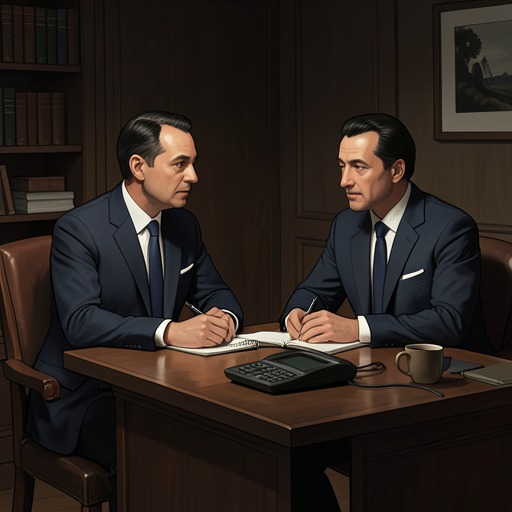
Patrick and Tom meet and grow closer through the portrait project
My PolicemanPatrick and Tom’s meeting through the portrait project turns an artistic arrangement into a private encounter, then into a pattern of return. Patrick chooses Tom as his first subject and invites him to sit at the flat that doubles as his studio; the dated entries of 8 and 15 October 1957 show the drawing sessions becoming charged with anticipation and personal attention. The event’s decisive movement is not simply that the work begins, but that Tom comes back after Patrick has sent him away: the project gives their closeness a reason to continue, while each man’s actions alter what the arrangement can mean.
The project becomes personal
At their initial discussion, Patrick asks whether Tom wants a woman to be part of the project. Patrick answers that perhaps she will be, but Tom is the first subject and they will see how it goes. The exchange places Tom at the centre of the work from its outset. It also gives the project a practical uncertainty: the possible involvement of another person remains open, but the first appointment is already theirs.
Tom is due to come on Tuesday. Patrick then changes the proposed venue, explaining that his office lacks both space and the necessary equipment. He hands Tom his card and suggests meeting at the studio at half past seven instead. When Tom asks whether it is the studio, Patrick confirms that it is also where he lives. The alteration is logistical, but it makes the sitting an invitation into Patrick’s domestic space, where work and private life occupy the same address.
The first sitting
The diary fixes the first evening precisely: Tuesday, 8 October 1957, at half past seven. Patrick waits at the window in a meticulously tidied flat; beyond it, the dark sea is still. The anticipation is registered bodily in the beat of his heart before the work has begun. That detail makes the appointment more than a neutral session with a model: Patrick’s excitement arrives before he can settle into the role of artist.
When Tom asks whether everything is all right, Patrick says that it is, sits back on the stool, and begins. At first, he can only look at Tom in quick peeks. He fears that close attention will make him laugh with joy, or even weep. The particulars drawing his gaze are Tom’s flushed cheeks and bright, interested eyes, his thighs held together as he sits, and the square set of his shoulders. Patrick tries to contain his response by concentrating on the drawing. Remembering his art teacher’s instruction to see an apple from the inside, he decides that he must regard Tom seriously enough to study him from within. The artistic discipline becomes a means of sustaining a gaze whose intensity is also personal.
Return and renewed intimacy
A week later, on 15 October, Patrick’s attention has also been occupied by his mother’s illness. He has considered whether she might die soon, whether she might need nursing in Brighton, and whether a nearby flat might be available. While preparing to write to her, however, he hears the buzzer. The competing worry does not erase his expectation of Tom: Patrick has prepared the spare room and admits to himself that he has been waiting for his policeman to return.
The diary emphasizes the interval between the first ring and the second. Patrick takes time to relish the anticipation and reread his unfinished letter; then the buzzer sounds again, long and impatient. He had sent Tom away before, so Tom’s return changes the balance between them in Patrick’s understanding. Patrick recognizes the decision as Tom’s: Tom is now the insistent one. Patrick gulps down the rest of his gin and goes downstairs to let him in. The renewed meeting therefore carries a consequence the first sitting did not: their continuation is no longer only Patrick’s hope or the project’s schedule, but also Tom’s chosen action.
Tom goes into the spare bedroom to change, while Patrick fetches him a beer and checks his appearance in the hall mirror, grinning at his reflection. When Tom calls that he is ready, he emerges dressed for Patrick and waiting to begin. Patrick draws him; afterward, they move to the sitting room for another drink. Tom unbuckles his belt, removes his jacket, lays it across an armchair, and sits on the chesterfield without being invited. Patrick notices the jacket’s limp shape without Tom inside it. The sessions still provide the outward structure of an art project, but the return, the preparation of the spare room, and Patrick’s close attention to Tom’s clothes and body show the encounter acquiring an intimacy that the formal task cannot contain.
Significance of the encounter
The episode establishes a repeated rhythm: an appointment is arranged, Patrick waits, Tom sits, and then the following week Tom comes back. Its movement depends on the difference between the men’s observable actions and Patrick’s inward response. Tom’s return is plain; its meaning is registered through Patrick’s anticipation, relief, and sense that the initiative has shifted. The portrait project permits sustained attention to Tom while giving that attention a respectable practical form. Yet the studio is also Patrick’s home, and the second sitting carries them from drawing into drinks and an uninvited ease in the sitting room. The arrangement thus begins as work but becomes the setting through which Patrick and Tom grow closer.